The Image in the Bed
The “Acted Parable
Bible Verse : 1 Samuel 19 : 13-17 “And Michal took an image, and laid it in the bed, and put a pillow of goat’s hair for his bolster, and covered it with a cloth. And when Saul sent messengers to take David, she said, He is sick. And Saul sent the messengers again to see David, saying, bring him up to me in the bed that I may slay him. An when the messengers were come in, behold, there was an image in the bed, with a pillow of goat’s hair for his bolster. And Saul said unto Michal, why hast thou deceived me so, and sent away mine enemy, that he is escaped ? And Michal answered Saul, he said unto me, let me go ; why should I kill thee ?”
In order to understand this “Acted Parable” we will first think about the Physical :
A (physical) woman took a (physical) image or idol and placed it in a (physical) bed in order to (physically) deceive people. The (physical) “head” of the (physical) image was a (physical) goat.
Now we will think about the Spiritual :
A (spiritual) woman took a (spiritual) image and placed it in a (spiritual) bed in order to (spiritual) deceive people. The (spiritual) “head” of the (spiritual) image was a (spiritual) goat.
Remembering what Paul said about all the things that happened to the children of Israel : 1 Corinthians 10 : 11 “Now all these things happened unto them for ensamples (models) and they are written for our admonition upon whom the ends of the world are come”.
We conclude then, that in the last days a similar event will happen. Thus a (spiritual) woman will take a (spiritual) image and put it in a place of (spiritual) rest (bed) and this will deceive people.
COMMENTS :
In order to understand the Spiritual meaning of this “Acted Parable” we need to locate the Key Words and discover their Spiritual Meanings.
- 22 -
Bible Verse : 1 Samuel 19 : 13-17 “And Michal took an image, and laid it in the bed, and put a pillow of goat’s hair for his bolster, and covered it with a cloth. And when Saul sent messengers to take David, she said, He is sick. And Saul sent the messengers again to see David, saying, bring him up to me in the bed that I may slay him. An when the messengers were come in, behold, there was an image in the bed, with a pillow of goat’s hair for his bolster. And Saul said unto Michal, why hast thou deceived me so, and sent away mine enemy, that he is escaped ? And Michal answered Saul, he said unto me, let me go ; why should I kill thee ?”
L in the verse : (usually nouns or “real things”) |
Discover their Spiritual Meaning (by using the Bible Word Pictures or a Concordance and Bible |
| Woman (she, Michal) | False church - Rev 17 : 1-6 |
| *Image (# 8655 - idol) | *something worshipped that looks like something else |
| Bed (place of physical rest) | Sabbath (Place of spiritual rest ) |
| Goat | Satan |
| Bolster (# 4763 - head) | Spiritual “head” - spiritual leader |
| Deceived (# 7411) | Delude, deceive, betray |
 ocate Key Words
A bed has only two functions :
1. It is a place of rest (Isaiah 57 : 2)
2. It is a place of relationship (Ezekiel 23 : 17)
A physical bed would provide :
1. A place of physical rest
2. A place of physical relationship
A spiritual bed would provide :
1. A place of spiritual rest
2. A place of spiritual relationship
The Bible only speaks of God having one “place” of rest.
Hebrews 4 : 4,5 “For he spake in a certain place of the seventh day on this wise and God did rest the seventh day from all his work. And in this place again, if they shall enter into my rest”.
Thus, God’s one “place” of rest or His “bed” is the seventh day Sabbath.
- 23 -
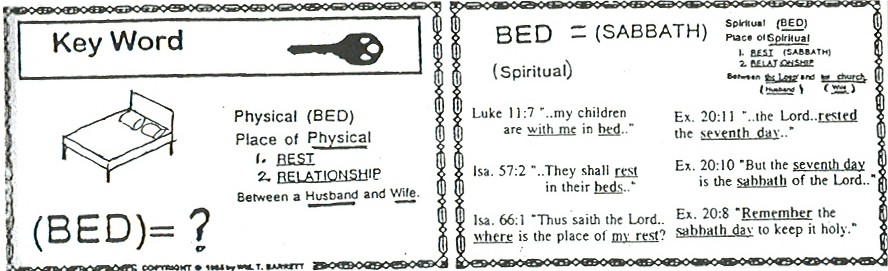
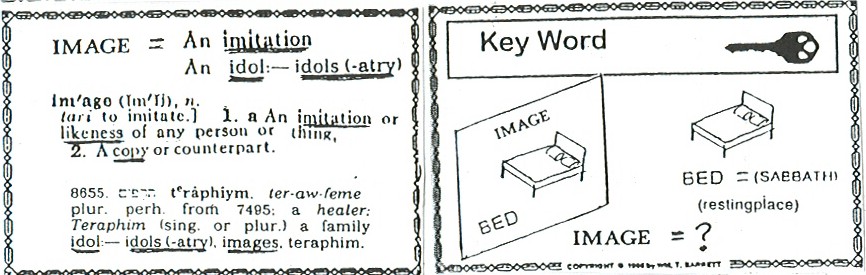
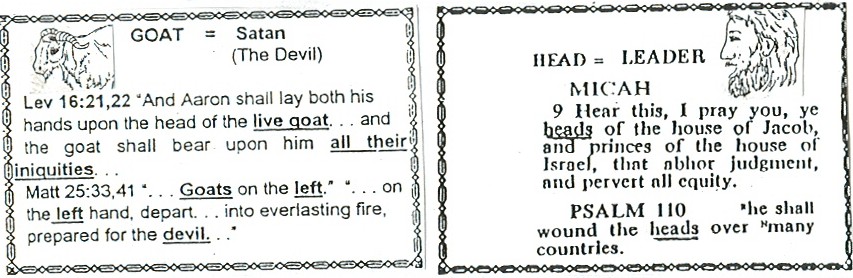
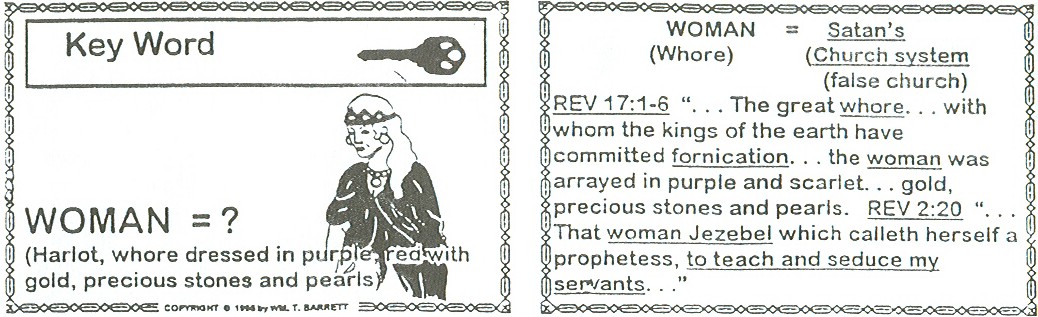
*image - something worshipped that “looks like” something else. Sunday the “image” of Saturday (the Sabbath)
What will the Main (Spiritual) thought be about ?
A (spiritual) woman took a (spiritual) image and placed it in a (spiritual) bed in order to (spiritually) deceive people. The (spiritual) “head” of the (spiritual) image was a (spiritual) goat.
PARAPHRASE :
A false church (woman) took a spiritual “image” or likeness of rest (Sunday) and put it in the place of God’s Time of Rest(7th day Sabbath)(bed) in order to spiritually deceive people. The spiritual “head” behind this deception was Satan (goat).
- 24 -
CONCLUSIONS
This “Acted Parable” is warning us that in the Last Days a Church will attempt to establish a time of worship that will be different from the time of worship established by God.
Aaron, the highest of the priests, made an image of a golden calf and then caused the people to worship it. This is called “idolatry” by the Bible. “Idolatry” is making an “image” or likeness of something and then using it in worship. (Exodus 20 : 4-6).
Thus this “Acted Parable” is warning us that a Church will make an “image” or likeness of God’s Time of Worship and will then cause the people to worship at the time she has set up.
If we worship the “image” of God’s Time of worship that has been set up by a church, then we will be committing idolatry.
God’s Time of Worship
Exodus 20 : 10,11 “But the seventh day is the Sabbath of the Lord thy God : in it thou shalt not do any work, thou nor thy son, nor thy daughter, thy manservant, nor thy maidservant, nor thy cattle, not thy stranger that is within thy gates : for in six days the Lord made heaven and earth, the sea, and all that in them is, and rested the seventh day : wherefore the Lord blessed the Sabbath day, and hallowed it”.
The “Image” of God’s Time of Worship
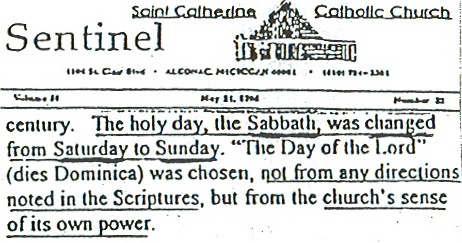
Mark 7 : 7-9 “Howbeit in vain do they worship me, teaching for doctrines the commandments of men. For laying aside the commandments of God, ye hold the tradition of men. And he said unto them, full well ye reject the commandments of God, that ye may keep your own tradition.
- 25 -
THE AMERICAN CATHOLIC QUARTERLY REVIEW
Volume VIII
FROM JANUARY to OCTOBER, 1883
THE OBSERVANCE OF SUNDAY AND CIVIL LAWS
FOR ITS ENFORCEMENT. 139
The Sunday, as a day of the week set apart for the obligatory public worship of Almighty God ; to be sanctified by a suspension of all servile labor, trade, and worldly avocations and by exercises of devotion, is purely a creation of the Catholic Church.
The Sunday laws are in their origin a part of the Catholic system enforced by the state when Europe was Catholic. The day and the regulations have no logical basis except the authority of the Catholic Church.
In the primitive days of fervor and piety all days were so consecrated by exercises of devotion that no special command for the sanctification of the first day is traced.
This became gradually obligatory, although the command was not at first peremptory. The Council of Laodicea, in 364 A.D, defines : “That Christians must not Judaize and refrain from manual labor on Saturday, but work on that day ; and that, preferring the Lord’s day, they must then rest, if this can be done, as becomes Christians”.
The Church thus began by calling her children to sanctify the first day of the week, that on which God the Son rose from the dead, that, on which God the Father began the creation of the world, and God the Holy Ghost descended on the Apostles. She commanded a laying aside of business, a refraining from servile work, as a means to the end she had in view, the sanctification of the day.
Constantine lent the power of the state to enforce the regulations of the Church, and the civil law began to enforce the spiritual decrees. He commanded the Lord’s day to be observed by all as a festival and day of rest.
Protestantism, in discarding the authority of the Church, has no good reason for its Sunday theory, and ought, logically, to keep Saturday as the Sabbath, with the Jews and Seventh-Day Baptists.
- 26 -